Safety Culture Is Built in Everyday Work
A campaign can introduce expectations. It cannot create the daily conditions that determine whether people speak up, stop unsafe work, follow controls and learn from weak signals.
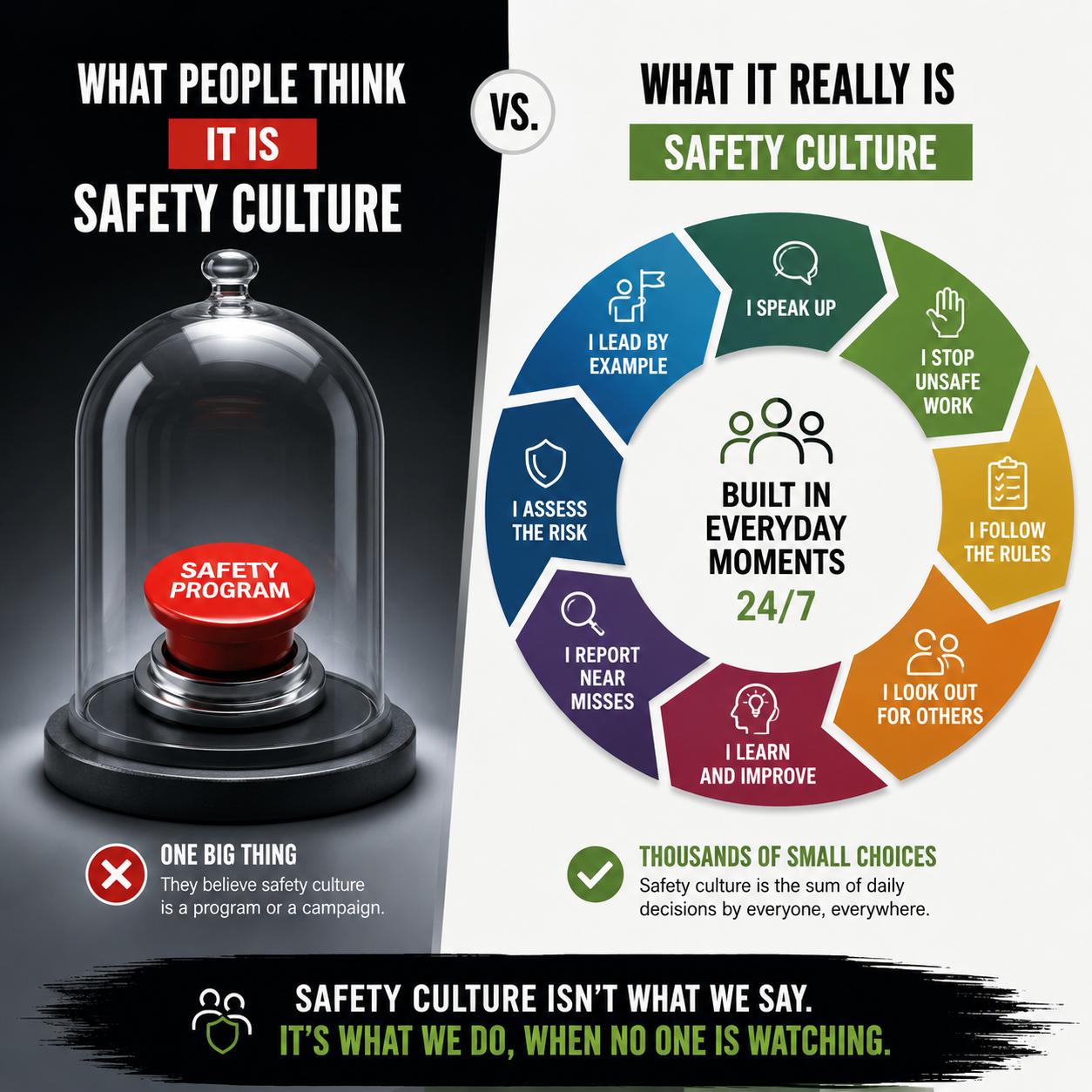
A program is visible. Culture is persistent.
A safety program has a launch date, an owner and a set of activities. Culture is harder to contain. It appears in the choices people make during routine work, especially when time is short, supervision is distant or the safest option is inconvenient.
UK HSE describes organisational culture as "the way we do things around here." That definition is useful because it shifts attention away from slogans and toward repeated practice. A polished campaign may influence practice, but it is not evidence that the organization has changed how work is planned, supervised or rewarded.
Everyday choices do not happen in a vacuum
The illustration makes a strong point: culture becomes visible when someone assesses a risk, follows a rule, reports a near miss, looks out for a colleague or stops unsafe work. Yet it would be a mistake to treat safety culture as the sum of individual character.
People make choices inside a work system. Staffing, equipment condition, contractor arrangements, production targets, supervisor behavior and access to technical support all affect what feels possible. If a worker must choose between meeting the schedule and following a procedure that cannot be performed with the available equipment, the problem started before that worker reached the job.
Leadership writes the practical rules
Workers pay attention to what leaders fund, tolerate and correct. A manager may say that safety comes first, then postpone safety-critical maintenance, accept repeated barrier impairments or reward a supervisor solely for output. The practical message is clear even when the formal message says something else.
OSHA's recommended practices ask management to provide sufficient resources, communicate its commitment and set an example through its own actions. This turns leadership into something that can be observed. Budget decisions, staffing levels, shutdown priorities and the response to a stopped job all say more than a poster.
Speaking up requires a credible response
Telling people to speak up is easy. The test comes after someone raises a concern. Do supervisors thank the person and investigate? Does the concern disappear into a system with no response? Does the worker lose overtime, status or future opportunities because the issue delayed work?
OSHA states that workers should be able to report safety and health concerns without retaliation and should have opportunities to participate in program design and implementation. Voice is therefore more than a reporting channel. People need access to information, time to participate and evidence that raising a concern leads to a fair response.
Stop-work authority includes the restart
A stop-work card or policy grants permission on paper. Culture determines whether that permission survives an inconvenient moment. The person who stops a lift, isolation or confined-space entry should not carry the burden of proving loyalty to production.
The restart matters as much as the stop. A competent person should confirm that the unsafe condition has been resolved and the required controls are available. If work resumes because the delay became expensive, the organization teaches everyone what its stop-work policy is worth.
Rules need workable conditions
Following rules is part of a sound culture, but compliance cannot depend on memory and determination alone. The correct equipment must be available. Procedures must match the job. Supervisors must understand the control standard, and workers need enough time to apply it.
Repeated deviation deserves investigation. It may involve misconduct, but it may also expose an outdated method, a missing resource or a conflict between the procedure and the installed equipment. Labeling every deviation as a behavior problem protects the paperwork while leaving the operating problem in place.
Near misses are tests of trust
A near-miss report gives the organization information before serious harm occurs. What happens next affects whether the next person reports. If the review searches quickly for someone to blame, reporting will fall. If leaders examine the event, correct the conditions and explain what changed, the system earns trust.
Learning also requires proportion. A low-consequence event involving high energy may need urgent attention even though nobody was injured. The actual outcome should not hide the credible potential.
Looking out for others is shared work
Peer care can catch fatigue, an incomplete isolation or a change in conditions that one person missed. It should support formal controls rather than replace them. Workers should not be expected to compensate indefinitely for weak planning, poor maintenance or inadequate supervision.
The ILO's occupational safety and health management guidance places responsibility with employers and competent institutions while recognizing a role for workers and their representatives. That balance matters. Everyone participates, but the organization retains its duty to organize safe work.
Test the culture during ordinary work
Do not wait for the annual survey or the next incident. Choose one ordinary shift and follow a material risk into the work. Ask what can cause serious harm, which controls must work and what makes those controls difficult to maintain. Watch what happens when someone finds a problem.
Then compare what you observed with the formal system. Did the team have the equipment, competence and time the procedure assumed? Did the supervisor protect the person who raised the concern? Did management correct the condition before restart? These observations provide a more useful culture check than campaign attendance alone.
Questions for leaders
What did the last work stoppage cost the person who raised it? Which safety-critical defect has remained open because production took priority? Where are workers compensating for a procedure or design that does not fit the job? What evidence shows that a reported concern led to a change? Which decision can you make now to remove a known constraint?
Sources and further reading
Author/editor: Myaser HSE Hub Editorial
Last reviewed: August 4, 2026
Image note: The concept illustration was supplied by Myaser Ibrahim. It is used to explain and critically examine the idea presented.
Disclaimer: This article provides general HSE education. Apply applicable law, standards, engineering judgment and competent professional advice to your operation.