Protect the worker
Hours, child labour, sanitation, guarding and inspection.
1802 → today
Industrial growth created new energy, scale and speed. Workers, reformers, engineers, investigators and regulators responded with rules, guards, training, management systems and, eventually, a sharper focus on the controls that prevent death and permanent harm.
Explore the timelineThe central shift
Each era added useful tools, but it also left blind spots. Prescriptive rules protected workers from visible machinery. Behavioural models drew attention to repeated events. Major disasters exposed design, governance and regulatory failures. Current practice brings these lessons together around material risk and control reliability.
Hours, child labour, sanitation, guarding and inspection.
Training, supervision, standard work and event ratios.
Risk assessment, management systems and process safety.
Critical controls, high-potential events, SIF and FPI prevention.
From your treasure chest
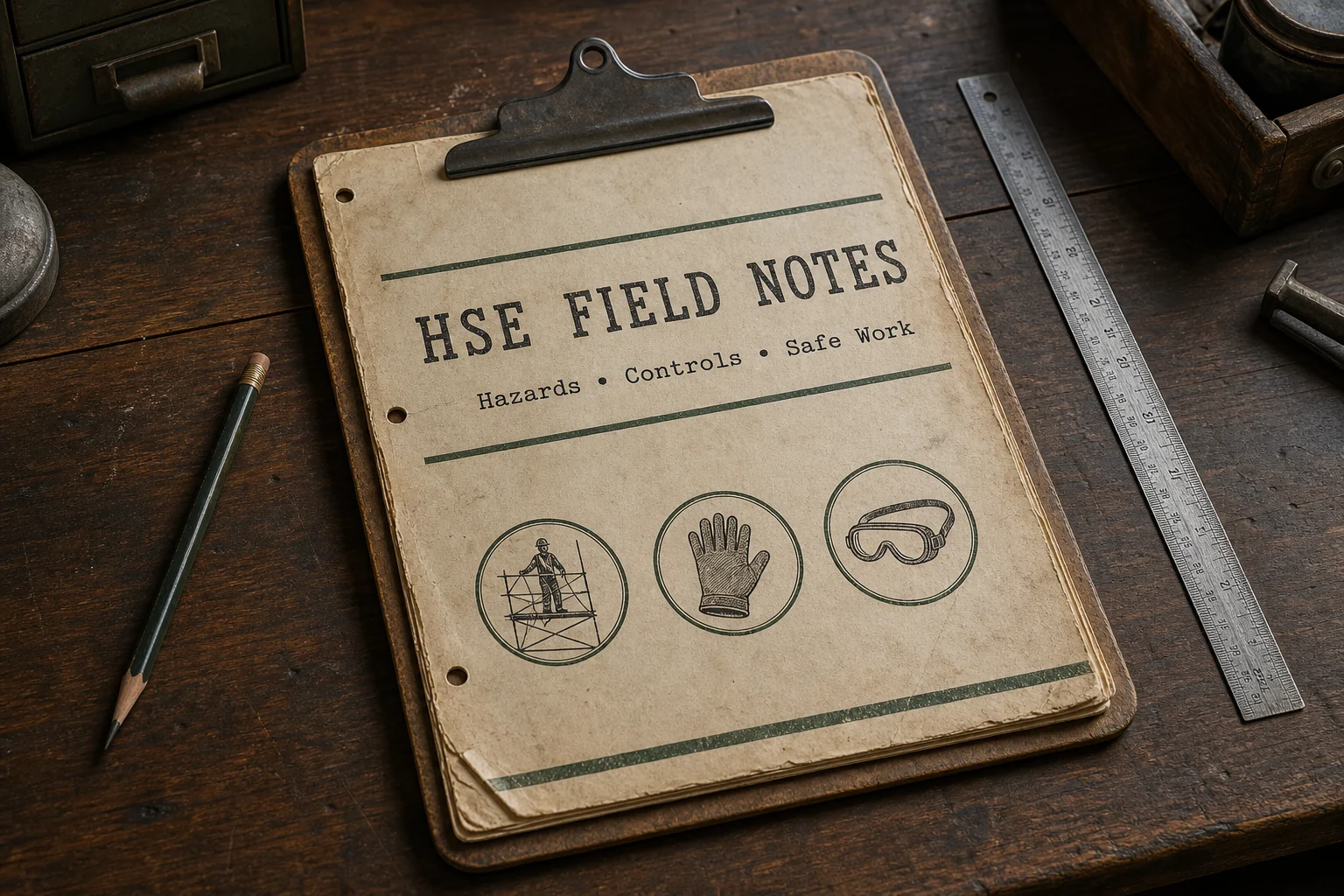
A supplied archival training manual describes a supervisor-led course built around demonstrations, safety problem sheets, job breakdowns, hazard spotting, practice drills and assigned responsibilities. That is recognizably modern in one respect: safety has to be translated into the job, not left as a policy.
Its limits are equally instructive. The material reflects an era centred on instruction, supervision and individual job performance. Modern HSE adds stronger attention to design, organizational conditions, worker participation, occupational health, major-accident hazards and control assurance.
Interactive history
Use the whole history
Safety practice becomes weaker when one model is asked to explain every type of harm.
Useful for encouraging reporting and learning before injury. Weak when a fixed ratio is treated as universal or minor-injury reduction is assumed to prevent every fatality.
Useful for defining responsibilities and repeatable processes. Weak when documents and audit scores are mistaken for field control effectiveness.
Useful for fatal-risk pathways, high-potential events and barrier health. Weak if occupational disease, wellbeing or everyday injuries disappear from attention.
Editorial note
This timeline uses official and primary sources where practical. Corporate histories are labelled as such. Fatality totals and causal interpretations can change across inquiries and later research. The page avoids treating any event as having one simple cause.
Read the editorial policy